
We all like to think we’re in control, of our time, our choices, our facial expressions in meetings. But often, what we call “being in control” is really avoidance, with good PR.
It often starts with one uncomfortable thing: a conversation we don’t want to have, a decision we keep postponing, a truth we’re not ready to face.
Take one of my coaching clients. Smart, respected, deeply competent, the kind of person whose calendar looks like a game of Tetris with no space left. She came to Clarification Coaching because something felt… off. Not burnout. Not breakdown. Just a creeping sense that she wasn’t being herself anymore. One situation kept coming up: a colleague who subtly, repeatedly, undermined her. Not in dramatic ways. More like: “Oh, I thought you were going to lead that differently, ” “Are you sure that’s how we should present it to management?” Always in public. Always with a smile.
And instead of responding, she did what many of us do: she nodded. She smiled. She rewrote her emails five times. She told herself, “Stay professional.” Or, in other words, “Say nothing and quietly lose the will to live.” She was trying to stay in control.
But it wasn’t control. It was avoidance. It’s like putting the scary Tupperware at the back of the fridge. It still smells. You just can’t see it. And like most avoidance, it started to spread. She found herself hesitating before speaking in meetings. Checking and rechecking things she’d normally trust herself on. She even considered leaving the job — not because she wanted to, but because staying felt like a constant emotional drain.
That’s the hidden cost of avoidance. In some offices, ‘conflict avoidance’ is considered a soft skill, like ‘managing expectations’ and ‘smiling while your soul leaves your body.’ It looks like control. But it feels like tension, stuckness, second-guessing. And it grows quietly, while you convince yourself you’re being “professional.”
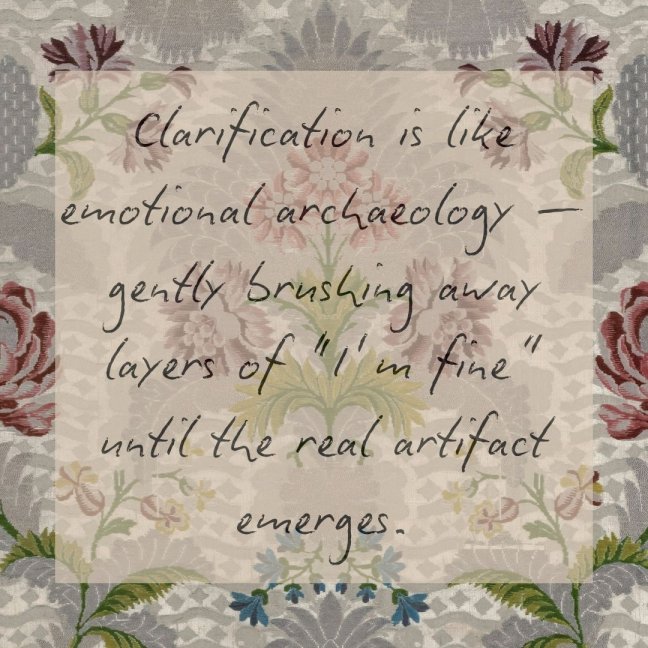
In Clarification, we didn’t talk it through endlessly. We went into the body. Into the reactions that had been happening mid-meeting, mid-sentence, mid-smile. We witnessed the shortness of breath. The muscle contractions in the face, the stomach the arms. The hunched posture. We unpacked what those signals meant not just intellectually, but emotionally and contextually. And something clicked.
Two weeks later, she told her colleague, “When you correct me in meetings, it affects how I speak up. If you have feedback, I’m happy to discuss it — just not in front of the team.” Calm. Clear. No performance. Just truth. Her colleague’s behaviour changed, their communication and relationship improved.
She got her voice back, not because she learned a “communication technique,” but because she stopped ignoring what her body had been screaming for months. And she acted from that clarity.
So let me ask you:
What are you calling “professionalism” that might actually be silence? What are you calling “calm” that might actually be fear? And what if real control doesn’t mean avoiding discomfort, but paying attention to it, learning from it, and deciding what you want to do next? Your body already knows.
Want to learn how to really listen to yourself?
Book a call.